
24 August 2016
2 mins clock icon

Oil demand shows signs of strain

The benefit of lower oil prices for demand is starting to show signs of waning as key markets cope with as much oil as they can handle.

nodding_donkey

Oil markets have managed to escape the clutches of the bear market they were stuck in from late May until the end of July, in part helped by news that OPEC countries would hold an informal meeting on the sides of an energy event in Algeria in September. The prospect of OPEC cutting output or reintroducing the freeze seems to have captivated markets but we doubt that an agreement will be achieved at the event. Since these proposals were last floated, more OPEC members have seen production disrupted, most notably Nigeria, and we think it is highly unlikely that any member will voluntarily limit production.

While it doesn't quite capture the headlines as much as surging output from major producers like Saudi Arabia (which self-reported a blistering 10.67m b/d of output in July), we think that the outlook for demand will be keeping oil ministers a little uncomfortable in their seats in Algiers. Since the oil price began its current slump the market's attention has been on how quickly supply can be cut to help alleviate the downward pressure on prices. A bump in demand in relation to low was taken as a given and indeed oil consumption did rise at its fastest pace in 2015 (1.86m b/d according to the IEA) since the post financial crisis recovery in 2010.

However, that low price-high demand effect has shown signs of waning and with prices expected to continue their upward grind into 2017 (we forecast Brent at an average of USD 55/b next year, some ways between market consensus and the current forward strip) consumers may begin to reevaluate how much marginal oil they need. 
Oil agencies have a mixed outlook for next year
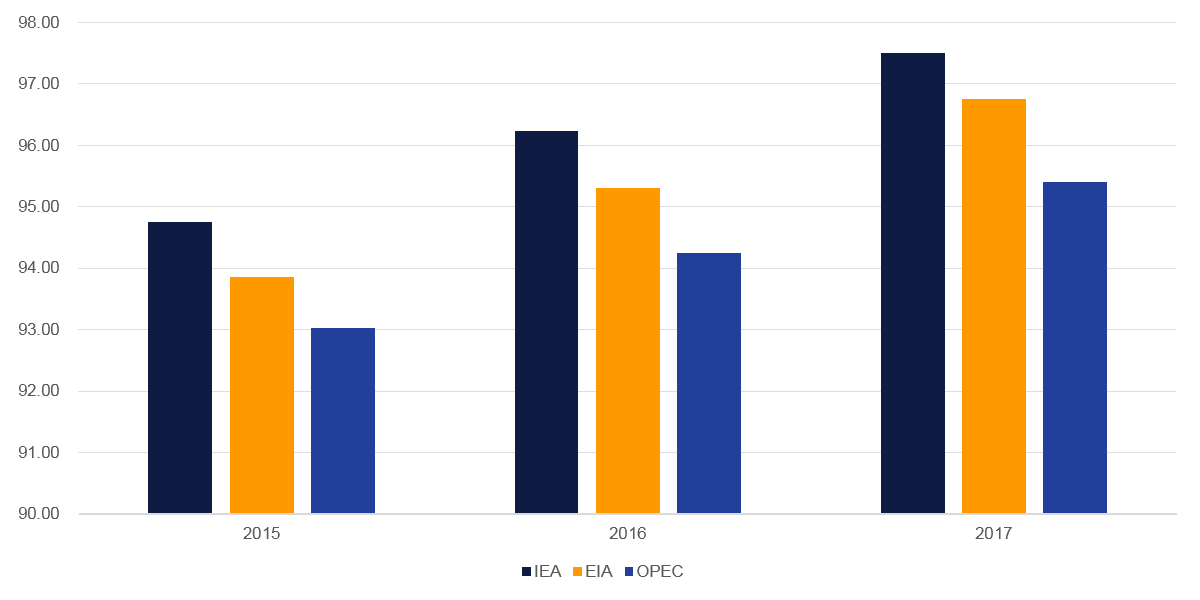
The three major oil market institutions—the IEA, OPEC and the US government's EIA—all project oil consumption growth will slow in 2017 albeit with considerable divergences in their forecasts. The most bullish is the EIA which expects growth of 1.44m b/d in 2017, only marginally slower than their estimate for this year. More significantly, the EIA has kept its outlook for 2017 reasonably stable with a slight upward bias since its initial projections in January. OPEC is the most bearish, anticipating demand growth of just 1.16m b/d in 2017 compared with 1.22m b/d this year. OPEC has only published two forecasts for 2017 so far but its outlook is much closer to the 10-year average for oil demand estimated by the IEA of a little more than 1m b/d. The IEA splits the difference with a forecast of 1.2m b/d of demand growth in 2017, a slowdown from 1.4m b/d this year. 

Agencies expect slower demand growth

Oil agency forecasts
Source: IEA Oil Market Report, EIA Short-Term Energy Outlook, OPEC Monthly Oil Report, Emirates NBD Research.
 

 For full details please click here.

Written By


There was an error during your feedback!

Your feedback is valuable to us and will help us improve.

More from {0}

Related Articles

Subscribe to our newsletter and stay updated on the markets

There was an error during your newsletter subscription!

Please try again to stay updated with all the latest financial news and valuable insights.

Thank you for newsletter subscription!

To stay updated with all the latest financial news and valuable insights.