
Recent Search
Popular Searches


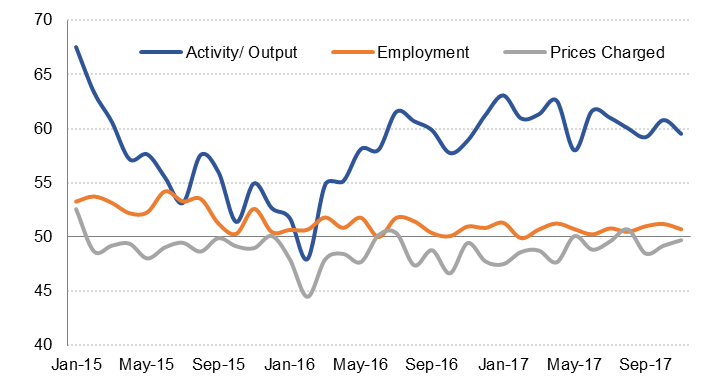
The Emirates NBD Dubai Economy Tracker Index (DETI) was marginally lower at 55.3 in November, not much different from September and October readings. The strength of the overall index is underpinned by strong growth in output (59.5) and new work (59.7). However, employment was broadly unchanged in November, with less than 1% of firms surveyed reporting hiring new workers last month.
Selling prices showed a marginal decline in November, although input costs increased. The lack of pricing power underscores the strong competition for new business, and this is unlikely to change in the coming weeks in our view. Nevertheless, firms remained optimistic on average in November, with nearly 13% of respondents expecting their output to be higher in a year’s time, and the rest expecting no change. Inventories increased at a solid rate in November, although the index was down from the October high.
The sector surveys showed wholesale & retail trade outperforming the other sectors for the sixth month in a row in November. The sector is likely to continue to do well in December as many consumers will bring forward purchases before VAT comes into effect in January.
 Source: IHS Markit, Emirates NBD Research
After posting a record high in October, the wholesale & retail sector index eased to 57.5 in November, still signalling strong expansion in the sector last month. Output and new work increased sharply (albeit slightly slower than in October) and employment also increased in the sector last month. Nevertheless, the overall rate of job growth remains modest.
Encouragingly, the strong sector performance did not come on the back of further price discounting: average selling prices were marginally higher last month compared with October. However, input costs rose at a faster rate than output prices, so margins remain under pressure. Inventory accumulation remained high in November, as firms likely anticipated further strengthening in demand in December. While we expect the trade sector to do well into year-end, the introduction of VAT is likely to have a negative impact on consumer demand in the first few months of 2018.
After several months of exceptionally strong output growth in the construction sector, the output index eased to a still-high 59.7. New work growth also slowed last month but remains firm with the index at 57.4. The overall construction sector index fell to 54.5 from 56.3 in October, the lowest reading since February, but it remains well in expansion territory. Moreover, firms remain optimistic about the prospects for the coming year, as Expo 2020 projects are expected to underpin activity in the sector.
Given the sharp rise in output and new work last month, it is surprising to see employment broadly unchanged. Input costs in the sector increased at the fastest rate on record, as both raw materials and wages increased according to the survey. While some of the higher input costs were passed on, average selling prices rose to a lesser extent than input costs, so firms remain under pressure to boost efficiencies and reduce costs.
The headline travel & tourism sector index declined to 52.0 in November from 53.9 in October, the lowest reading in a year-and-a-half. While the survey still shows expansion in the sector, the growth momentum has slowed sharply over the last three months compared with earlier this year. This is most evident in the new work index, which fell to 53.6 in November from 57.4 in October and from an average of 60.9 in January through August. Business activity (output) also rose at a slower rate last month, and employment was unchanged.
Output prices in the travel & tourism sector declined for the third month in a row in November, despite slightly higher input costs. Nevertheless, firms in this sector were more optimistic on average than both construction and wholesale & retail trade firms surveyed in November. The business optimism index for travel & tourism rose in November to the highest level this year.


 Emirates NBD Research