
Recent Search
Popular Searches

.jpg?la=en&h=600&w=800&hash=EDC56B9A24609FD2EC604BDCE0FB5556)
 Source: Bloomberg, Emirates NBD Research
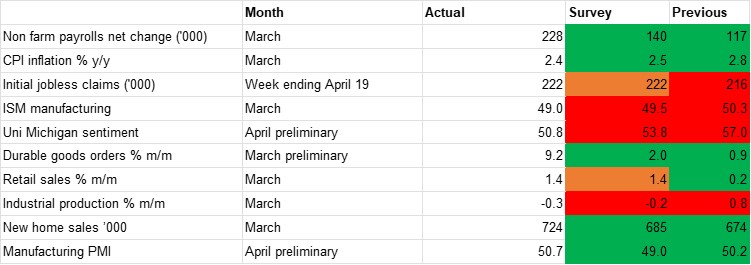
Our macro scorecard for US data points released over the past month has held up fairly well given the high levels of uncertainty surrounding the US trajectory at present; many of our most-followed indicators are still green, meaning they came in stronger than both the previous month and consensus expectations. That said, most of these data points cover the period immediately prior to US President Trump’s so-called ‘Liberation Day’ on April 2 when tariffs were announced for every trading partner, initially at levels of 10% and above before a roll-back brought all countries save China back to the baseline 10% level. There had already been moves around tariffs prior to April 2 but these were more limited in scope, covering individual countries (Canada, Mexico), or industries (automotives, metals). With this in mind, the likelihood is that there will be a deterioration in the data over the coming months, and this was highlighted by the IMF’s real GDP growth downgrade for the US announced this week, when it slashed its 2025 projection to 1.8%, from 2.7% previously.
What has already been apparent in recent months is that the soft data – surveys – has turned weaker ahead of a more material deterioration in the hard data, eg spending data, factory orders and the like. Consumer sentiment has taken a clear move downwards, with the University of Michigan index falling to just 50.8 in March, down from 57.0 the previous month and the US Conference Board index falling to 92.9, down from 100.1 in February. This was the weakest reading since 2021, while the expectations component was at the weakest in 12 years. Business confidence has also slumped as shown in the most recent S&P Global manufacturing PMI survey, where optimism fell for the third straight month to its lowest level since July 2022. There has also been a marked shift higher in inflation expectations with the Michigan survey showing year-ahead expectations at 6.7%, up from 5.0% in February and the highest since the early 1980s.
This expectation of faster price growth to come likely explains in part why some of the hard data has performed more resiliently than anticipated to date, with there being a suggestion that both consumers and businesses have been front-loading their purchases in order to get ahead of any incipient inflationary shock. US retail sales surprised to the upside in March as they grew 0.5% m/m, beating the predicted 0.4%. Stripping out volatile automotives and gas, growth was a robust 0.8% m/m, matching the upwardly revised pace from February. Businesses have also been looking to get ahead of the game with the ISM manufacturing survey for March showing an uptick in inventories after six-months of contraction even as demand declined.
The high level of uncertainty will make the Federal Reserve’s rate-setting decisions more difficult, especially in an environment of heightened political pressure from the White House to cut more swiftly. Officials had previously said that they were looking through the noise around tariffs as far as possible, but this has started to change as successive surveys have shown inflation expectations heading higher. Chair Jerome Powell explicitly highlighted the threat posed to their ‘goals’ (maximum employment and stable prices) by the government’s policy changes when appearing at the Economic Club of Chicago last week and reiterated that ‘without price stability we cannot achieve long periods of strong labour market conditions.’
For the time being, the key data points for the Fed have held up well. The labour market remains robust despite the slump in optimism and well-publicised job cuts by DOGE, with the March non-farm payrolls report stronger than expected at 228k jobs added with an increase in both private sector and government jobs. On the other hand, CPI inflation fell to 2.4% y/y in March, much slower than February’s 2.8%, while prices were down 0.1% m/m, the first monthly deflation in nearly five years. While tariffs will likely lead to an acceleration in price growth through the remainder of the year – and the IMF has revised up its 2025 inflation forecast to average 3.0% compared to the January projection of 2.0% – we still see scope for three rate cuts from the Fed with the expectation remaining that there will be room to move to a less restrictive policy, especially if growth and labour market signals start flashing red.
 Daniel Richards

 Facebook
 Twitter
 Linkedin
 Email
Email