
Recent Search
Popular Searches

.jpg?la=en&h=600&w=800&hash=911AF292A433C213455BB25451523740)
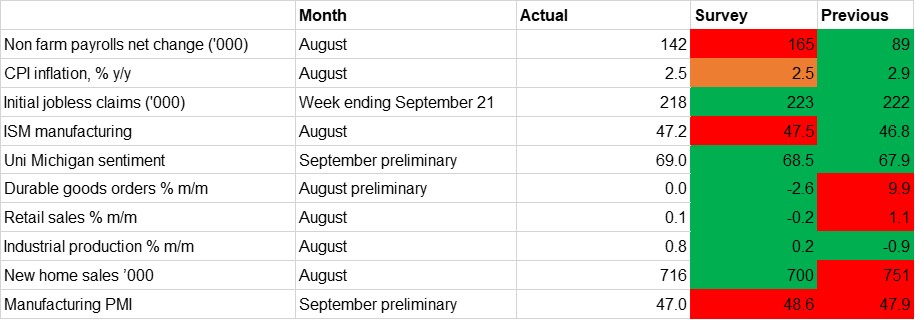 Source: Bloomberg, Emirates NBD Research
In the month of the first rate cut in four years by the FOMC, the data in our monthly macroeconomic scorecard for the US would appear to chime with comments by Fed Chair Jerome Powell at the post-meeting press conference that there is nothing ‘in the economy right now that suggests that the likelihood of a… downturn is elevated.’ While some data has been coming in softer, as would be expected and indeed desired at this point in the cycle, most of the key data points have held up fairly well. For this past month there is markedly more green than red in our scorecard, in accordance with Powell’s view that ‘the US economy is in good shape.’
On the labour market, Powell said that it was still at ‘very solid levels’ and this appears a fair assessment. The monthly NFP report has been trending lower, but it is not flashing alarm signals. August’s net gain of 142,000 was higher than the (downwardly revised) 89,000 the previous month, although it did fall short of the predicted 165,000. The unemployment rate was fractionally lower in August at 4.2% from 4.3% in July but average hourly earnings came in hotter than expected at 0.4% m/m and 3.8% y/y. Meanwhile, initial jobless claims in the week to September 21 fell to just 218,000, down from an upwardly revised 222,000 the previous week and beating the predicted 230,000. This marked the lowest weekly print since May, although data from the Conference Board did suggest that workers are becoming more concerned about finding jobs.
On the other side of the Fed’s dual mandate, Powell observed that inflation was coming down, with headline CPI inflation at 2.5% y/y in August, down from 2.9% the previous month. This was in line with expectations. Lower energy prices exerted the primary drag on prices meaning that core inflation stayed at 3.2% y/y for the second month running. With global oil prices under pressure in September, energy will likely continue to temper headline inflation figures next month. However, services inflation has remained fairly sticky and while we changed our outlook on rates for the remainder of 2024 to a further 50bps of cuts (in line with the revised dot plot) we expect that this will be delivered in two 25bps moves rather than a further large hike. As Powell said in reference to the FOMC’s 50bps cut, ‘I do not think that anyone should look at this and say ‘Oh, this is the new pace.’’
The start of the Fed’s easing cycle should be supportive of the other data points in our scorecard, not least new home sales with mortgage rates already falling for the eighth week straight in the week to 20 September. While sales did come in lower in August, at 716,000, down from 751,000, the previous month had seen a remarkably strong performance, and the August number was still comfortably higher than the predicted 700,000. Lower borrowing costs should also support household consumption, with retail sales coming in fairly mixed last month. While the headline figure exceeded expectations as it expanded 0.1% m/m, when stripping out autos and gas, growth was below expectations with an expansion of 0.2% rather than the predicted 0.3%.
Capital goods orders should also benefit from lower rates and have also maintained positive levels in recent months. On the headline measure, orders were flat m/m in August, but this compares to the high 9.9% growth in July and was far better than the predicted 2.7% decline. The core measure, meanwhile, rose by 0.2% m/m. Firms appear positive over the medium-term outlook, but uncertainty around the upcoming November election is causing some near-term cautiousness that could outweigh the benefit of rate cuts through the end of the year.
 Daniel Richards

 Facebook
 Twitter
 Linkedin
 Email
Email