
Recent Search
Popular Searches


The US has put eight Chinese technology companies on a blacklist citing human rights violations. The firms are prohibited from doing business with US entities unless they are granted a special license. The move comes ahead of high level trade talks between the US and China which are due to start on Thursday, and although the US has said its decision to blacklist the Chinese firms is unrelated to the trade dispute, it makes a positive outcome from this week’s talks less likely.
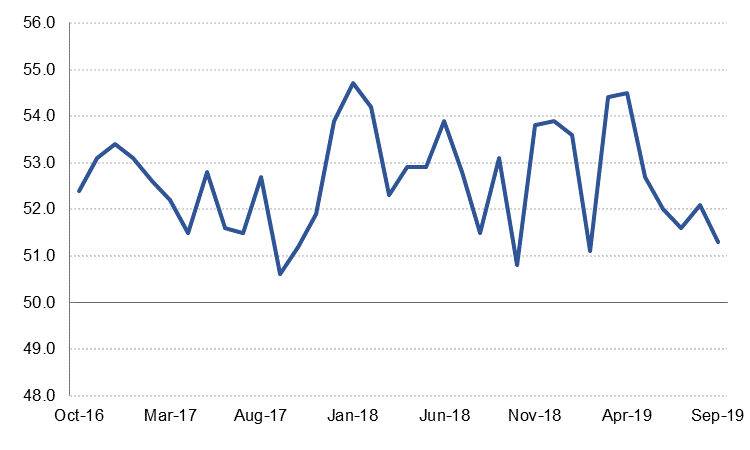
The Caixin China services PMI slipped to 51.3 in September from 52.1 in August, and was below the consensus forecast of 52.0. The reading was the lowest since February this year and indicates that while the services sector remains in expansion territory, growth momentum has slowed.
German factory orders declined by more than forecast in August, falling -0.6% m/m (-6.7% y/y), against expectations of a -0.3% m/m drop. However, the July figure was revised slightly higher. Nevertheless, the data suggests that German industrial output, due to be released today, could also disappoint.
The recent slew of disappointing economic data from around the world supports the view expressed by World Bank president David Malpass, who said the global economic outlook is even weaker than the WB had projected in their June report. Malpass cited Brexit uncertainty, trade tensions and the downturn in Europe as reasons for the deteriorating outlook.
Market focus today will likely be on Jerome Powell’s speech to the National Association for Business Economics conference later today, where he may provide some clues on monetary policy.
 Source: Bloomberg, Emirates NBD Research
Treasuries gave up some of the previous week’s gains in what was a rather dull trading session. The curve bear flattened with yields on the 2y UST, 5y UST and 10y UST closing at 1.46% (+6 bps), 1.39% (+5 bps) and 1.55% (+3 bps).
Regional bonds remained in a tight range as the focus of investors remain on the flurry of primary issuances on the horizon. The YTW on Bloomberg Barclays GCC Credit and High Yield index was largely unchanged at 3.22% while credit spreads tightened 5 bps to 170bps.
Aldar Properties has mandated banks for a sukuk which is expected to be priced as early as this month.
Fitch downgraded Saudi corporate following the cut to the sovereign rating last week. The corporates included Sabic and Saudi Aramco whose rating were lowered to A..
This morning the dollar is almost unchanged against a basket of currencies, the Dollar Index (DXY) trading flat at 98.966. While the price remains above the 50-day moving average (98.383), the path of least resistance is for further upside.
This morning’s outperformer is the NZD which has gained following the release of 12-mointh financial statements from the government. As we go to print NZDUSD is trading 0.42% higher at 0.63157. Resistance can be expected near 0.6380, not far from the 50-day moving average (0.6379) and the 23.,6% one year Fibonacci retracement (0.6385).
Developed market equities closed mixed as investors hedged their bets ahead of formal trade talks between the US and China. The S&P 500 index dropped -0.5% and the Euro Stoxx 600 index added +0.7%.
Regional equities closed mixed. Egyptian equities rallied sharply amid reports of further assistance from the IMF. The EGX 30 index gained +1.5% on the back of strength in market heavyweights. Ezz Steel gained +18.1% after the government reduced the cost of gas for various industries including metals. Elsewhere, weakness in banking stocks dragged the Tadawul (-1.1%) lower.
Oil markets held relatively steady to begin the week with Brent futures closing nearly unchanged while WTI dipped by just 0.1%. Both contracts are up this morning as unrest in several producers—namely Iraq and Ecuador—is raising concern over security of supply. Ecuador recently announced plans to leave OPEC to try and raise production but protests at several oil fields have forced the country’s national oil company to shut in production.
US-China trade talks resume later this week and their outcome could help to set the trajectory for oil in the coming weeks. Hopes for a deal were quashed over the weekend as the Chinese authorities are reportedly seeking to work on trade issues topic by topic, rather than achieve an all-encompassing deal.
OPEC’s secretary general, Mohammed Barkindo, said the producers’ bloc was not considering a change in its production cut target despite Brent futures falling back below USD 60/b.


 Emirates NBD Research