
Recent Search
Popular Searches


The UK’s economy grew by 0.3% q/q in Q3, avoiding two consecutive quarterly declines and a technical recession. On an annual basis the economy expanded by 1%, its slowest pace since 2013. Consumer spending remains the main support for the economy while industrial production continues to contract. Even though the UK managed to avoid a recession, the paltry pace of growth will reaffirm the Bank of England’s views to keep rates accommodative and any further slowdown in Q4, along with prolonged uncertainty related to the outcome of Brexit and the December general election, may tip more policymakers towards cutting rates at upcoming meetings.
The UK’s prime minister, Boris Johnson, received a boost to his Conservative Party’s electoral chances when the Brext Party leader, Nigel Farage, announced he would not run candidates against Conservatives. This will likely help to build support for the Conservatives ahead of the December election as they won’t need to fight off challenges from hard Brexit supporting candidates. Farage will instead target anti-Brexit parties such as the Liberal Democrats and Labour in certain constituencies. Sterling spiked on the news that a Conservative government looks assured as the outcome of December’s vote.
India’s industrial production figures showed more weakness in the economy as output fell by 4.3% y/y in September, its steepest decline since 2009. Capital goods orders sank more than 20%, sending a worrying signal about the strength of India’s industrial core at a time when global growth remains weak and the US-China trade war hasn’t shown any signs of being resolved. GDP data for the three months up to September will be released at the end of November with the market expecting growth of around 5.5%, an improvement from 5% in the prior quarter. However, the persistent slowdown in India’s economy will keep policymakers on an accommodative footing.
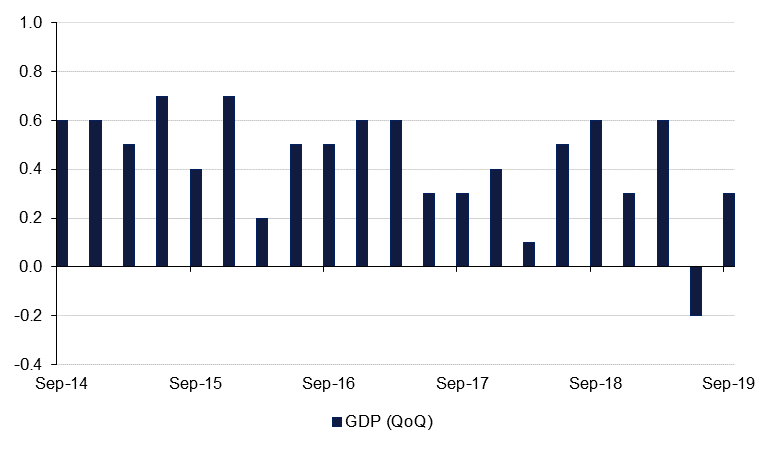 Source: Emirates NBD Research
It was a dull day of trading on account of US holiday. Regional bonds closed largely unchanged with the YTW on Bloomberg Barclays GCC Credit and High Yield index at 3.33% and credit spreads at 148 bps.
This morning, the NZD is the weakest performing major currency following softer than expected economic data. After Q4 2019 2 year inflation expectations fell from 1.9% q/q to 1.8% q/q, the kiwi has come under selling pressure. As we go to print, NZDUSD is trading 0.41% lower at 0.6333, near a two-week low. Looking forward, the market will be keeping an eye on tomorrow morning's RBNZ meeting at which policy makers are expected to cut interest rates by 25bps to a new record low of 0.75%. Should policy makers deviate from market expectations, and keep rates on hold at 1.00%, NZDUSD could climb higher.
Developed market equities closed lower as investors exercised caution amidst mixed signals on the trade front and rising geopolitics tension. The S&P 500 index and the Euro Stoxx 600 index closed -0.2% and -0.1% respectively.
Regional equities closed mixed. The DFM index gained +0.5% on the back of strength in Emaar-related shares following better than expected corporate earnings. Emaar Properties and Emaar Development added +1.0% and +3.9% respectively.
Oil prices started the week on a softer footing as uncertainty over the chance of a trade deal between China and the US weighs on markets while comments from Oman’s oil minister suggested that no deeper OPEC+ production cuts would be coming at the upcoming meeting. Brent futures closed Monday down 0.5% at USD 62.18/b while WTI was off by 0.7% at USD 56.86/b. Both contracts are losing ground in early trading today.
ADNOC confirmed that it will list its Murban futures contract on a new exchanged based in Abu Dhabi and operated by the ICE, the exchange that operates the Brent futures contract. Murban futures are set to launch in H1 2020 and are meant to attract liquidity from importers and traders seeking to more accurately price risk for crude flows from the Gulf region to Asia.
 Edward Bell

 Facebook
 Twitter
 Linkedin
 Email
Email