
Recent Search
Popular Searches


US President Donald Trump was inaugurated overnight and immediately began to enact executive orders that set a tone for his new administration. Many of the executive orders focus on social issues in the US and President Trump declared a “national emergency” at the US-Mexico border to address the flow of migrants and illegal narcotics into the US.
Several of the executive orders will have substantial economic and market impacts.
Markets have interpreted the executive orders announced so far as disruptive to global trade. Both the Mexican Peso and Canadian Dollar weakened considerably against the US dollar following President Trump’s comments on tariffs while the absence of a specific tariff on China has seen the CNY rally sharply.
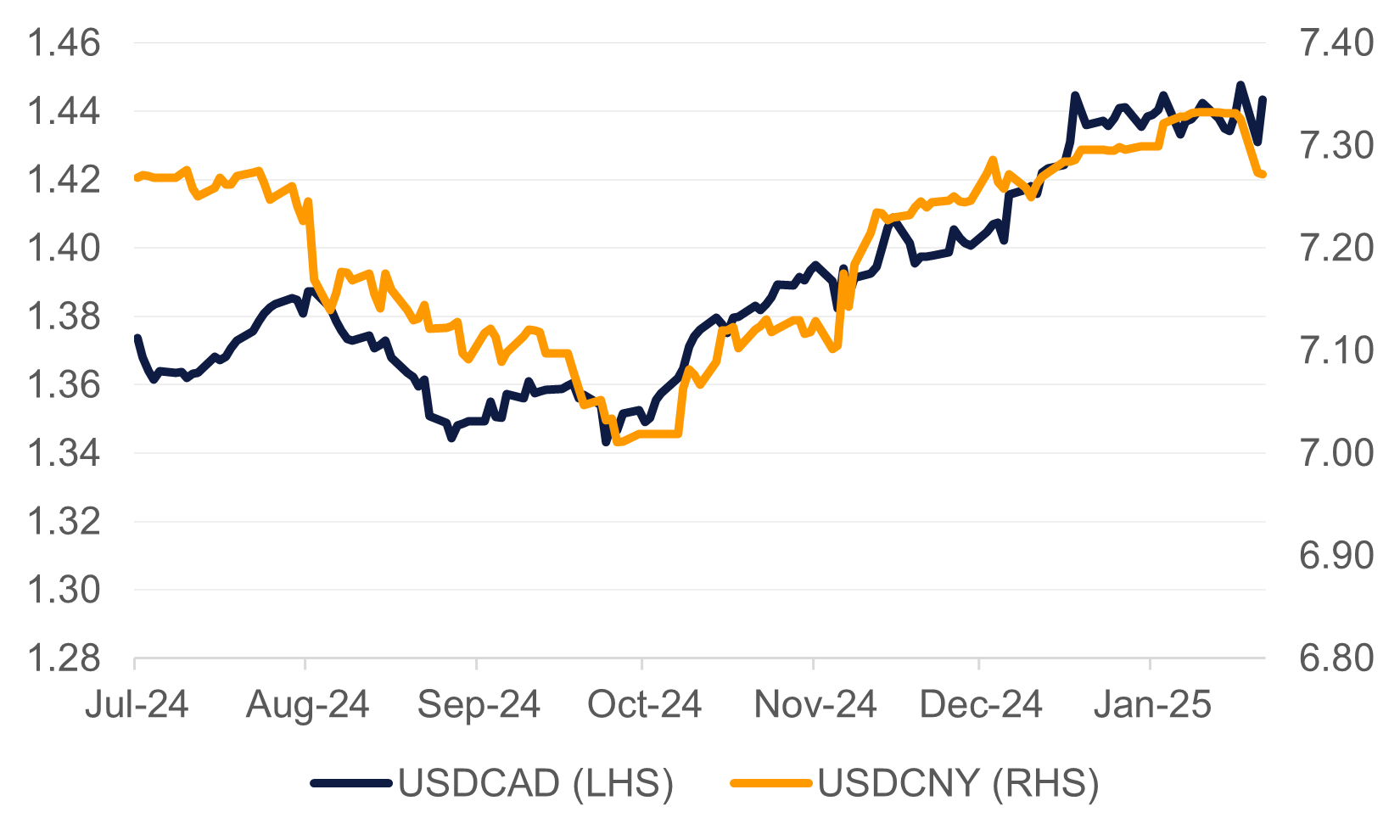 Source: Bloomberg, Emirates NBD Research.
US Treasury markets were closed overnight for a US public holiday but have opened stronger in early trade today as markets seem to downplay the inflationary risks of trade policies announced so far. Markets are pricing in around 44bps of cuts (almost two 25bps cuts) by the end of the year in early trading following the first day of President Trump’s new administration. That compares with less than 38bps of cuts priced in at the end of last week.
Energy markets were choppy in response to the announcement of a national energy emergency. Brent futures dropped by about 0.8% to USD 80.15/b overnight while WTI is testing lower levels in early trade today. Henry Hub natural gas futures didn’t trade overnight but have opened 3% lower at USD 3.829/MMbtu.
For the economies of the GCC the absence of an announcement on a universal tariff is a positive though it would present a challenge if the Trump administration did choose to implement it. The UAE in particular is an open, trade dependent economy and the threat of global trade disruptions could be a challenge. The development of additional US energy resources, including exports of oil, products and natural gas, will also represent a risk for the GCC economies in a global competition for market share.
As far as exposure to direct tariffs, the GCC economies do not appear as priority targets for the new US administration. For both 2023 and 2024 all of the GCC economies ran trade deficits with the US (importing more from the US than they exported) as hydrocarbon exports from the region have dropped substantially. In October 2024, the US imported just 221k b/d of oil and products from Saudi Arabia, down from around 1m b/d a decade earlier.
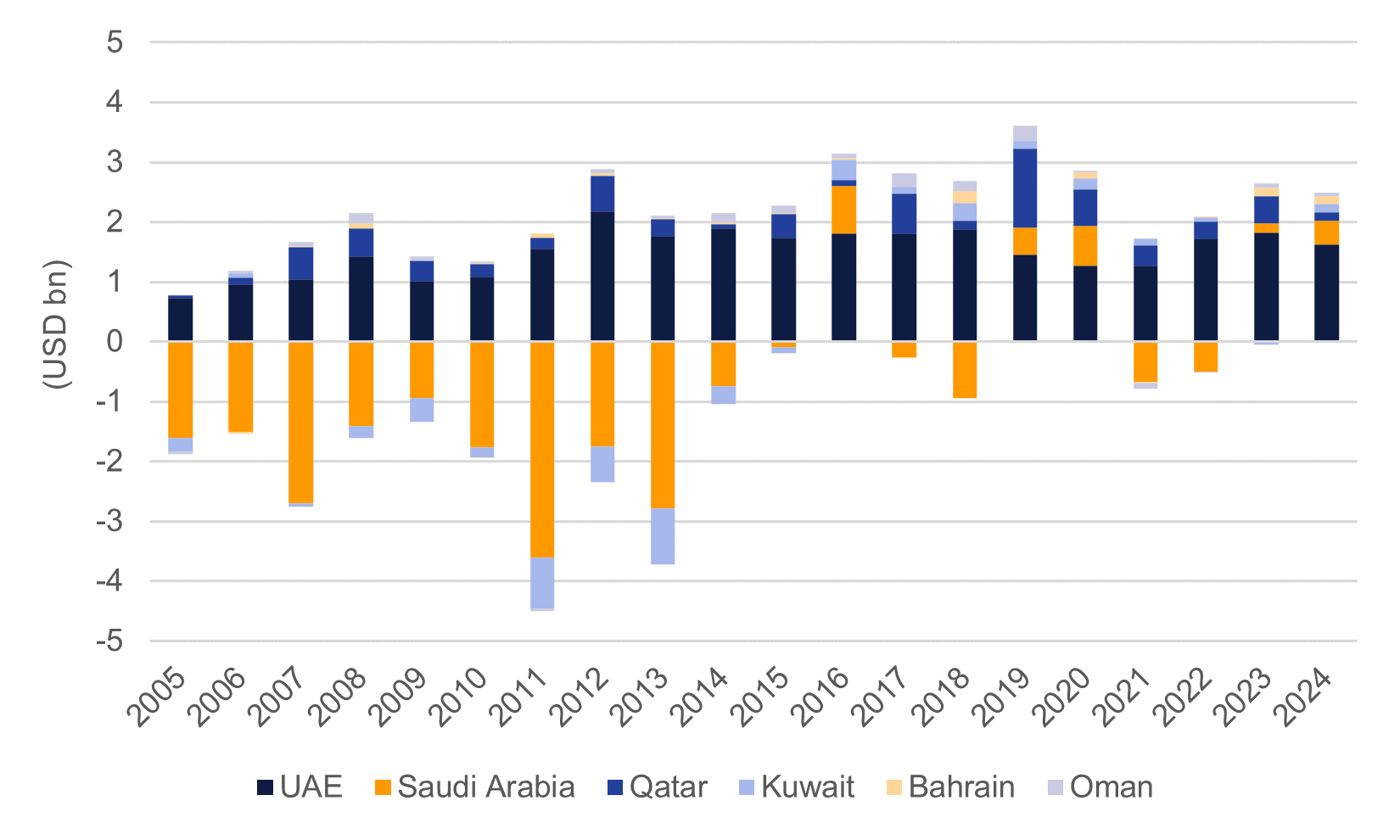 Source: Bloomberg, Emirates NBD Research.