
Recent Search
Popular Searches


Trade issues once again returned to the fore over the UAE’s long weekend, with President Trump restoring tariffs on steel and aluminium exports from Brazil and Argentina and threatening tariffs on USD 2.4bn of luxury products from France. The latter was in addition to other tariffs proposed on a broader range of EU exports to the US. Perhaps most unsettling for markets was President Trump’s comments yesterday that he was in no rush to reach a trade agreement with China and that this may only happen after the US elections in November 2020. At this stage, it appears as if the tariffs on Chinese imports that were scheduled to come into effect on 15 December will in fact go ahead, unless there is significant progress on a “phase 1” deal in the next fortnight. Most major equity markets closed lower yesterday, while US bond prices rallied.
Manufacturing survey data from the US was mixed for November, with the ISM manufacturing index moving deeper into contraction territory at 48.1, while the manufacturing PMI came in slightly better than expected at 52.6, suggesting some stabilisation in the US manufacturing sector. The Eurozone manufacturing PMI was fractionally better than the flash reading, but still deep in recession territory in November.
Saudi Arabia’s PMI rose to 58.3 in November, the highest reading since August 2015, as strong domestic demand underpinned faster new order growth last month. Output also increased at a sharp pace in November, contributing to the overall high PMI, as did the rise in inventories. However, the growth in the volume of output and new work has not led to significant job growth in the private sector – the employment index was unchanged from October at 51.1.
Egypt’s PMI declined to 47.9 in November, the lowest reading since September 2017, as both output and new work contracted at a steeper rate than in October. Weaker external demand appeared to be a contributor to the decline in new orders, as new export orders fell for the second month in a row. Private sector employment declined on average for the first time in four months. On a more positive note for consumers, selling prices declined in November at the fastest rate since the PMI survey began in 2011.
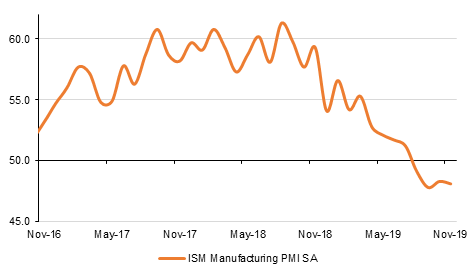 Source: Emirates NBD Research, Bloomberg
Treasuries rallied sharply as trade risks came back to the fore. Investors appear to be pricing in a protracted trade war which would force the US Federal Reserve to cut rates again. Yields on the 2y UST and 10y UST closed at 1.53% (-7 bps) and 1.71% (-10 bps) respectively.
Regional bonds moved higher in line with changes in benchmark yields. The YTW on Bloomberg Barclays GCC Credit and High Yield index dropped 3 bps to 3.24% and credit spreads widened 8 bps to 158 bps.
Developed market equities closed lower following comments from US President Donald Trump on trade deal with China. The S&P 500 index and the Euro Stoxx 600 index dropped -0.7% and -0.6% respectively.
Regional equities closed mixed. The Tadawul gained +0.6% on the back of strength in banking stocks. Al Rajhi Bank and Alinma Bank gained +1.1% and +0.9% respectively.
Oil markets will be trading rumor and news emanating from the OPEC+ meeting at the end of this week with expectations ranging from an extension of the current production cuts to deeper cuts or efforts to improve compliance. Brent futures slipped slightly overnight but are up strongly this morning at USD 61.32/b (0.8%) while WTI at USD 56.54/b is up by the same amount.
API data showed a drop in US crude stocks of 3.7m bbl last week although there were gains in products. Official data from the EIA will be released later today.


 Emirates NBD Research