
Recent Search
Popular Searches


Saudi Arabia’s headline Purchasing Managers’ Index (PMI) was fractionally higher in March at 56.8 (56.6 in February). Output increased at a similar rate to February and new order growth was slightly faster. Encouragingly, new export orders did not decline for a third consecutive month.
Private sector employment declined slightly on a seasonally adjusted basis in March. This was the first time the employment index fell below the neutral 50-level since March 2014. Backlogs of work were also broadly flat in March, suggesting that there is ample business capacity despite rising output and new work.
Selling prices declined for the fifth month in a row, and there has been little evidence of input cost inflation over the last few months either. The PMI survey data chime with official inflation data which show the cost of living declining on an annual basis in January and February 2019.
Businesses in Saudi Arabia’s private sector remain optimistic about their output next year, although the degree of optimism has softened since the start of 2019, and the ‘future output’ index was the lowest since September 2018.
The average PMI reading for Q1 2019 was 56.5, signalling the fastest expansion in the non-oil private sector since Q4 2017. However, the rebound in new orders and business output in recent months has not fed through to job growth, with private sector employment declining for only the third time in the series history last month. There also appears to be very little pricing power for firms, with selling prices declining (albeit only marginally) for the fifth month in a row.
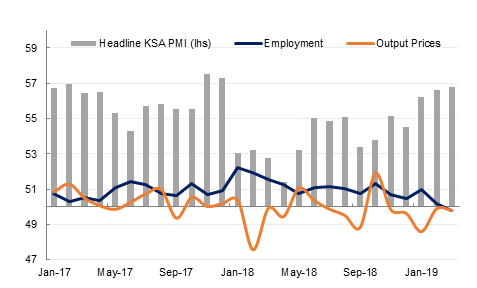 Source: IHS Markit , Emirates NBD Research


 Emirates NBD Research