
Recent Search
Popular Searches


Saudi Arabia’s budget deficit narrowed sharply in Q3 to -SAR 40.7bn (-USD 10.9bn) compared to –SAR 109.2bn in Q2. However, the deficit was still wider than that recorded in Q3 2019.
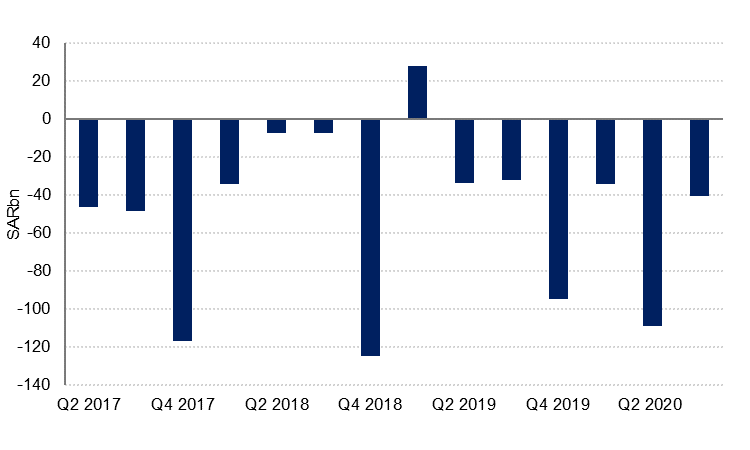 Source: Ministry of Finance, Emirates NBD Research
The main driver of the improvement was a sharp rise in non-oil revenues (up more than 200% q/q and 63% y/y) on the back of higher VAT and other tax revenue, as well as a jump in investment and other income. The rise in non-oil revenue likely reflected a recovery in activity as lockdown restrictions were eased following a sharp contraction in Q2. Oil revenue was down -3.3% q/q and -30% y/y in Q3 2020. Total budget revenue in Q3 was up 61% q/q and 4.1% y/y.
Government spending increased 5.4% q/q and 7.1% y/y in Q3, as the government resumed spending on goods & services, social benefits and capital spending post-lockdown. On an annual basis, spending growth was strongest on subsidies, grants and social benefits.
Year-to-September, total budget revenue declined -24.1% over the same three quarters in 2019, while spending was down -3.4% y/y over the period. The cumulative budget deficit for the first three quarters stood at -SAR 184.1bn. Total budget financing reached SAR 186.7bn, with the over-financing to be used in Q4. In addition, the official statement indicated that SAR 45bn worth of domestic debt issuance was “remaining” which would be used to finance the budget shortfall in Q4 2020. This makes it less likely that the government will issue external again this year, and is likely to wait until Q1 2021 to tap external capital markets.
The stock of public debt stood at SAR 847.8bn at the end of September, and we expect this to rise to SAR 892bn by the end of the year, or 34.3% of estimated GDP.
Separately, monetary and financial statistics released by SAMA on Wednesday showed a –USD 5.8bn decline in net foreign assets at the central bank in September to USD 443bn.
Money supply growth accelerated to 10.6% y/y, reflecting a 2.8% m/m rise in quasi money (term and FX deposits). Private sector credit rose 1.4% m/m and 15.0% y/y in September, while claims on the public sector declined -2.1% m/m, leading to slower annual growth of 16.0% y/y.
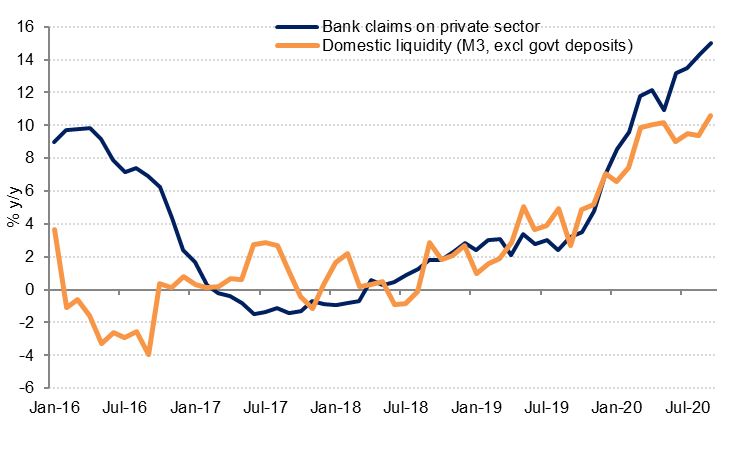 Source: SAMA, Emirates NBD Research
The value of point of sale transactions grew 6.6% m/m in September – the first m/m increase since the higher VAT rate came into effect in July - and 33.7% y/y.


 Emirates NBD Research