
Recent Search
Popular Searches

The UAE’s headline PMI slipped further in February to 49.1, the second consecutive sub-50 reading. All components of the headline index softened last month as businesses started to grapple with the impact of the coronavirus on supply chains and demand. Output declined for the first time since January 2010, while new orders fell for the second month in a row. As a result, both the quantity of purchases and stocks of inventories fell in February. Employment declined slightly as well. Somewhat surprisingly, price discounting was the weakest since September 2018, perhaps reflecting a desire by firms to prevent further margin erosion.
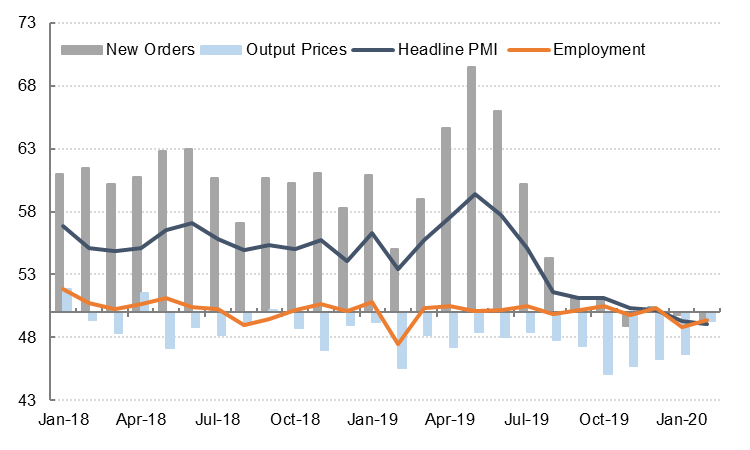 Source: IHS Markit, Emirates NBD Research
Saudi Arabia’s non-oil sector growth slowed in February, but the PMI remained in expansion territory at 52.5. Output and new work increased, but at a markedly slower rate, with new order growth the softest in nearly two years. Employment in the non-oil private sector was unchanged in February, while suppliers’ delivery times increased slightly. Firms discounted prices in February against a backdrop of weaker demand, even as their input costs rose at the fastest rate in 17 months.
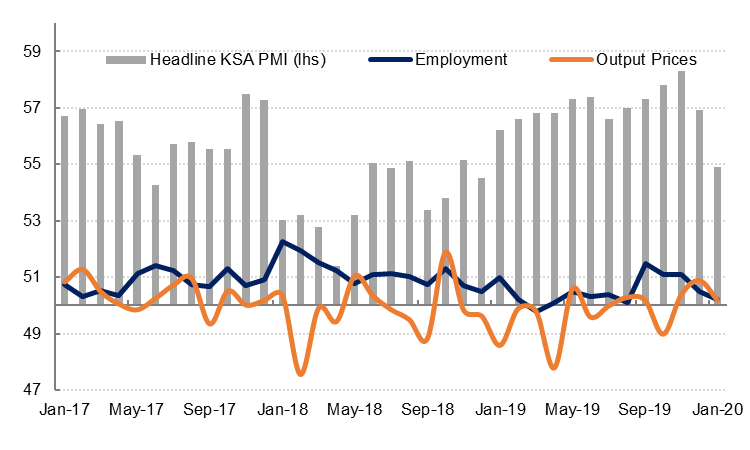 Source: IHS Markit, Emirates NBD Research
The downside risks to our 2020 GDP growth forecasts are mounting for both the oil and non-oil sectors. The OPEC+ meeting is the next key event. If - as we expect - the decision is made to deepen production cuts further or to extend the existing curbs beyond end-March, we will need to revise our growth forecasts for oil exporting countries lower. We would also take into account the softer non-oil sector PMI data, and the impact of further travel disruptions since the February survey was done.
Egypt’s headline PMI figure improved to 47.1 in February, up from a near three-year low of 46.0 in January. Nevertheless, this remains far off the neutral 50.0 level, and is below the series average of 48.4, suggesting that the long-awaited recovery in the non-oil private sector remains beyond the horizon. Egypt has not had a positive PMI reading since July 2019, and with new orders still weak, it is unlikely that this trend will be reversed in the near term, especially should the impact of the global coronavirus outbreak begin to weigh on the economy. New export orders were especially soft, remaining near the multi-year lows seen in January.
The contractionary environment continues to weigh on the private sector labour market. The survey data showing a fourth consecutive month of job losses, which will impede any future recovery in domestic consumption – although positively, staff costs posted a 12th positive reading running. With regards future expectations, respondents remain positive, although this has fallen to the lowest level since September.
 Daniel Richards

 Facebook
 Twitter
 Linkedin
 Email
Email