
Recent Search
Popular Searches


As part of ongoing Brexit negotiations, the EU’s chief negotiator, Michel Barnier, is believed to have called for a) guarantees on free movement for EU citizens, b) EU sign-off on external trade-deal revisions made during the transition, and c) no change to fishing rights in U.K. waters for the duration of the transition period interim period. Having a final trade deal before Brexit appears more critical for UK than for the EU given that EU accounts for nearly 50% of UK’s trade while UK accounts for only circa 5% of EU’s trade as at 2016.
The Moroccan authorities have taken the first steps towards a floating currency by widening the band within which it allows the dirham to trade on January 14. It can now move within a daily limit of 2.5% above or below the official rate, compared to the 0.3% either side previously. This step has been long-mooted and had been scheduled in 2017, but was postponed after a rush on foreign currency prompted a precipitous fall in reserves in June. Concerns over the disorderly removal of the Egyptian pound’s peg in November 2016 may also have played a part. However, Morocco, a regional top-pick which is attracting considerable foreign investment already, is loosening its peg from a position strength, and we do not expect any negative fallout from this move.
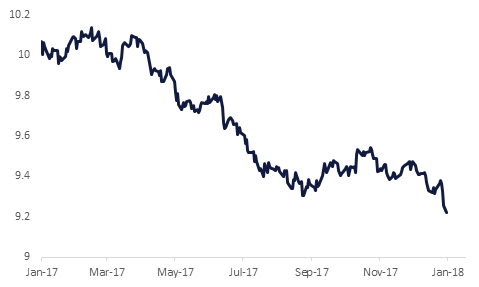
People’s Bank of China raised the yuan-dollar central parity rate to 6.4574, its strongest fixing since May 2016. Looking ahead, China GDP scheduled for release during the week is expected to reflect slightly weaker growth of about 6.7% vs 6.8% in the previous year.
 Source: Bloomberg, Emirates NBD Research
Positive sentiment on the economic growth in the US continued to support increase in UST yields. Following after the holiday on Monday, yields on 2yr UST were up by a bp to 2.01% while those on 10yr closed unchanged at 2.55%. Ongoing difficulties in Brexit negotiations saw yields on 10yr Gilts declining 2bps to 1.32% with Bund yields remaining range-bound at 0.58%.
Regionally GCC bonds were largely unchanged, though bonds from Qatar were a tad weaker on the back of unconfirmed news about Qatar fighter Jets intercepting Emirates flight. Yield on QATAR 19s rose nearly 10bps to 2.52%.
Banks from Oman commenced the earning announcements with most coming ahead of analyst’s estimates. Bank Muscat reported net income of OMR 177 million for FY2017 vs estimate of OMR 170 million. National Bank of Oman reported net income of OMR 44 million vs estimate of OMR 38 million and Bank Dhofar had net income of OMR 48 million vs estimate fo OMR 43 million. In another corporate development, Emaar properties approved cash dividend of AED 4 billion to be paid out of the Emaar development IPO proceeds.
In the primary market First Abu Dhabu Bank raised $610 million in Formosa bond.
Dollar stablised somewhat after a week of continued declines as investors take note of fundamentals. That said, EUR and GBP retained their strength, closing at 1.2259 and 1.3788 respectively.
The yen halted a five-day advance as Japanese Finance Minister Taro Aso said sudden moves in exchange rates are a problem, while declining to comment on levels. Yen closed weaker against the dollar at 110.94. Focus remains on China’s yuan, trading at the strongest level in more than two years and prompting speculation about possible steps to cool its gains. USDCNY is trailing at 6.4315
INR was a strong performer against the dollar, rising to 63.49 even though the country faces increase in budget deficits arising from higher oil prices and possibly increased government spending.
Global equities had a day of mixed performance. US markets were closed for Martin Luther Holiday and European bourses were subdued with Euro Stoxx 50 and FTSE 100 finishing the day close to their opening levels. Asia has opened firmer this morning as Hang Seng gained 1.25% in early morning trades.
GCC markets were mixed too. Tadawul was up 0.56%, followed by Abu Dhabi exchange gaining 0.37% as banks report solid earnings. However Qatar index fell 2.48% on fears of escalating conflict. Fall in real estate names caused Dubai markets to lose -0.49% .
Brent futures closed above USD 70/b for the first time since the end of 2014 yesterday as Iraq affirmed its commitment to cutting production. Market structures weakened slightly; the Brent 1-2 month backwardation narrowed while Dec spreads have also flattened off around USD 4/b for Dec 18-19 in Brent.
Market anticipation that OPEC will exit its production cuts early appears to be gaining ground but is at odds with public statemetns from oil ministers from leading OPEC producers. While we still expect to see some deterioration in compliance this year, a complete shift to unbridled production would undo in large part the process of market rebalancing.


 Emirates NBD Research


