
Recent Search
Popular Searches


President Trump has officially nominated Jerome Powell, to be the next Chair of the Federal Reserve, replacing Janet Yellen when her term expires on 01 February 2018. By way of background, Jerome Powell is a lawyer rather than an academically trained economist and would be the first chair without an economic doctorate since Paul Volcker who served from 1979 to 1987. The majority of his other experience has been in investment banking and private equity. However, he joined Federal Reserve Board of Governors in 2012 and therefore was involved in the decision-making behind QE3 and policy normalization in recent years.
Powell may not have the depth of economic expertise expected by the market but that is unlikely to matter for now, while the waters are relatively calm and the course of Fed’s policy well-set. Will he emerge as a capable and strong leader when the cycle turns and the FOMC has to change course is still some way off. His Senate nomination hearing in the coming months will provide the first insight into what type of Fed Chair he will be. Regardless of his performance at the hearing, however, his nomination is expected to be confirmed without too much drama.
We have no expectations that the change of Fed Chair in February next year will trigger any change in the monetary policy regime and expect that the UST curve will remain hinged against the improving economic growth in the US.
From the market perspective, Powell’s nomination represents continuity, given his reputation as a centrist on the monetary policy spectrum, aligning his views with that of the consensus. In fact, in past speeches he has often referenced how the committee thinks rather than what he thinks. We expect a Powell-led Fed to stick with the current narrative of structurally lower growth and interest rates. That said, a lot still depends on who Trump picks to fill the other vacancies on the Fed’s Board. With Powell’s promotion, there will be four vacancies, including for the Vice Chair position. Policy communications may become a bit muddled in the short term, if Powell doesn’t provide strong intellectual leadership and the policy debate descends into a free-for-all among regional Fed Presidents.
Beside an unchanged path of rate hikes in the immediate term, it will be interesting to see if the FOMC, under Powell’s Chairmanship, changes its view about long-term rates and therefore the terminal rate in this hiking cycle. The Fed, in its September meeting marked down estimates for long-run interest rates to 2.75%. In contrast, markets have been convinced for some time that the terminal rate in this cycle will be considerably below prior hiking cycles and will probably peak at only 2%.
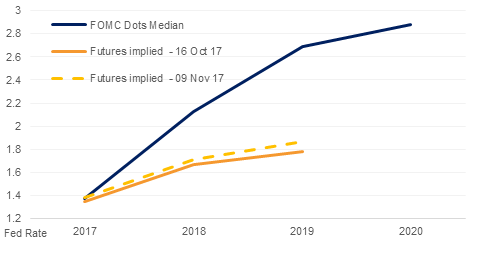 Source: Bloomberg, Emirates NBD Research
The Fed’s recent downward revision to long term rates was accompanied by estimate of GDP growth declining to 1.8%. However, if tax reform passes, the effect of transitory factors recede and progress is made on financial deregulation, then a pick-up in inflation expectations and higher structural rates could become a possibility. That said, these changes are more likely to be driven by uptick in economic data than on any material shift in the personalities at the Fed’s FOMC committee.
The seemingly endless flattening in the UST curve has continued post the Powell nomination. 10yr UST yields are at only 2.32%. Expectations of a reduction in growth and economic activity in the medium term, together with a global demand for yield has kept a lid on the 10yr UST yields despite the projected Fed rate hike cycle. The 2yr10yr spread at 0.67% is at nearly a decade low as the hiking cycle has bumped up the front end more so than the increase in 10yr yields resulting in this bear flattening. Weaker realized inflation from structural and idiosyncratic factors and now the continued tightening policy of the Fed is likely to keep inflation expectations low regardless of the change at the Fed.
We expect the Powell-led Fed to proceed with the current balance sheet normalization schedule. The latest FOMC meeting minutes showed no change in language around the balance sheet unwind that was announced at the September meeting and began in October. The FOMC wants to keep the balance sheet runoff on autopilot and markets have taken the start of the process in stride. There appears no need to deviate from this schedule in any way and fed Chair nominee, Powell will need overwhelming urgency to justify any change, which isn't the current base case.
While Powell is unlikely to change the path of Fed’s policy in the short term, he will likely put significant priority on scaling back financial market regulation. In recent speeches, he has stated “There is certainly a role for regulation, but regulation should always take into account the impact that it has on markets, a balance that must be constantly weighed. More regulation is not the best answer to every problem.” We think, he will work towards easing some of the burdensome regulations albeit with the goal of retaining the core post-crisis policies. He had recently highlighted below main points for possible regulatory reforms:
Powell is likely to make these adjustments soon after the appropriate due diligence has been conducted.
In conclusion, we believe that the change of the Fed Chair in February next year will not bring any material change in the monetary policy regime in the US, particularly as policy bias of future officials that will fill the current several vacant positions at the Fed board remain unknown.


 Emirates NBD Research