
Recent Search
Popular Searches


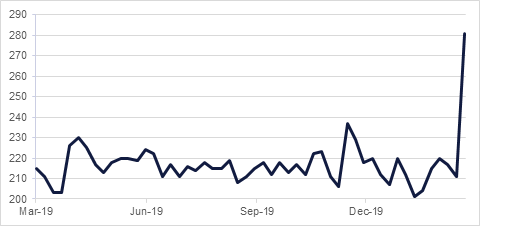
The coronavirus pandemic has shown no signs of abating, with the number of confirmed cases rising to 318,297 worldwide. The direct impact of the virus, and efforts to contain it, are having a devastating effect on economies around the world, with economic data globally now starting to confirm what market moves have been showing us for weeks. In the US, initial jobless claims, seen as an early gauge of the virus impact, shot up to a two-year high of 281,000 in the week ended March 14, far exceeding consensus expectations of 220,000. The likelihood is that this measure will see further strong gains in the coming weeks, and that unemployment will see similar rises across the world as hospitality and retail outlets are shuttered by governments.
In such an environment, the focus of government measures has become more granular over the weekend, as administrations look to soften the blow of job losses to individuals following earlier pledges to support business. The UAE government increased its stimulus package to AED126bn up AED16bn from before, and Saudi Arabia also boosted its stimulus by SAR70bn. In the UK, Chancellor Rishi Sunak pledged to cover up to 80% of worker’s wages if firms struggling due to the pandemic kept them on their payroll. Similar moves have been seen in Denmark, where 75% of workers’ wages will be covered, and France, where 84% of pay will be provided for the state. In the US, agreement over a USD 2tn stimulus package is still a work in progress, but bipartisan momentum for helicopter money direct to consumers is gaining.
These measures of support for individuals will strain government budgets, but most have shown willingness to abandon long-cherished rules around spending in what are clearly extraordinary circumstances. Norway will take USD 13bn form its sovereign wealth fund as struggles to deal with the twin coronavirus and oil price shocks, Germany is preparing to take EUR 150bn more debt in opposition to its balanced budget dogma, and Italy is being given free rein by the Eurozone to boost debt levels as the crisis mounts.
This extra fiscal firepower is welcome as it comes as central banks’ ammunition has been rapidly depleted, though institutions around the world continue to cut rates and employ financial crisis era engineering in order to stem the economic meltdown. There were 39 central bank rate cuts globally last week, with the Bank of England slashing the base rate back to historic lows of 0.1% on Thursday, coupled with a GBP 200mn to quantitative easing. Other measures being employed by central banks include emergency loan programmes and currency market intervention. Encouragingly, there has been some coordinated action as on Friday the US Fed extended its temporary swap lines to nine additional central banks, taking the total to 15 around the world. The swap lines will help ease stresses in dollar funding which have seen the dollar index rise to three-year highs.
 Source: Bloomberg, Emirates NBD Research
It was yet another week of volatile trading for treasuries. The 10y USTs traded in a 50 bps range for a third consecutive week as investors’ took in stride the various measures announced by the Federal Reserve. The first half of the week was marked by ‘sell whatever you can’ before that sentiment abated a bit in the second half following reports of a USD 2tn fiscal stimulus by the US Congress. Overall, yields on the 2y UST and 10y UST ended the week at 0.31% (-18 bps w-o-w) and 0.84% (-12 bps w-o-w) respectively.
Regional bonds continued to remain under pressure as investors took money off the table. The YTW on Bloomberg Barclays GCC Credit and High Yield index rose +102 bps w-o-w to 4.85% and credit spreads widened 110 bps to 399 bps.
Saudi Arabia plans to raise its government debt ceiling from 30% to 50% of economic output. The government said it can borrow as much as SAR 100bn in 2020 compared to earlier guidance of SAR 76bn as it increases spending to support the economy.
The USD surged last week as liquidity and funding became the paramount concerns in markets. Central banks deployed an array of new measures to help address these issues, including the Fed supporting the municapl bond market in the US. Perhaps the most important twas the expansion of US dollar liquidity swap arrangements to 15 central banks around the world.
GBP was the biggest major casualty of the USD’s surge, falling 6% over the week. Just as the markets were becoming concerned about a shortage of dollars, they also began to anticipate that London would be lockdown further reducing liquidity in the global FX market.
At the end of the week, the commitments by central banks and governments to backstop financial markets and key parts of their economies, from businesses to employees, appeared to be achieving some limited traction in the markets. The EUR and GBP were off their lows as the shutdown of California also slowed USD buying.
Regional equities started the week on a negative note as investors continue to remain cautious despite measures announced by governments to support the local economy. The DFM index dropped -2.1% while the Bahrain Bourse eased -1.0%.
Egyptian equities were a notable exception as the EGX 30 index rallied in excess of +6.0%. The decision of Banque Misr and National Bank of Egypt to support Egyptian stock market with a combined investment of EGP 3bn boosted investor sentiment.
Extensive government and central bank support measures have failed to cauterize the bleeding in oil markets with both Brent and WTI futures recording another week of more than 20% declines. As markets steel themselves for what may be double digit declines in GDP for Q2 in the US, Eurozone and likely the UK, oil prices will continue to be pulled lower as economic activity vanishes. Data out of the US will start to hit markets in coming days and weeks that demonstrates how badly oil consumption is being affected in the world’s largest consumer. As a tangible immediate effect, road congestion in New York City was running at around 15% during peak travel times in the past seven days compared with 50-60% on average during 2019.
The OPEC/Russia price war entered a new phase over the last few days as a senior energy market regulator from Texas was invited to participate in OPEC’s next meeting and proposed that the state would limit production by roughly 10% if OPEC members followed suit. However, the idea was quickly dismissed by many producers and US energy industry bodies. Given that OPEC+ with its 20 members was unable to come to an agreement to maintain production cuts we doubt how the literally thousands of companies that make up the exploration and production sector in the US would be able to reach any kind of consensus on the scale or duration of production cuts.
 Aditya Pugalia

 Facebook
 Twitter
 Linkedin
 Email
Email