
Recent Search
Popular Searches


Markets continue to be driven by the Coronavirus outbreak in China, where confirmed cases have soared to over 4,500. International firms have been evacuating workers from affected areas, while governments have been issuing travel warnings.
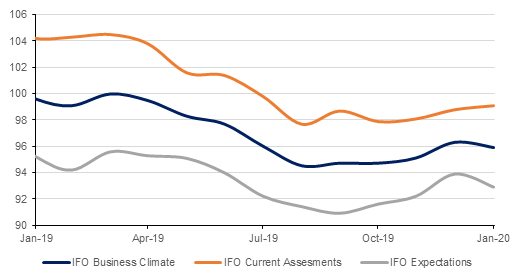
Germany’s IFO Business Climate survey for January, released yesterday, was fairly disappointing, declining on the previous month and missing expectations, and raising questions over the strength of any economic recovery this year. The index dropped to 95.9, down from 96.3 in December, and compared to a consensus projection of 97.0. This is in contrast to the improvement in the Eurozone’s manufacturing PMI released at the close of last week. The weaker-than-expected reading is perhaps indicative of how while the threat of trade wars may have diminished the threat to manufacturing, the pass-through is making itself felt in other facets of the economy, and Germany’s recovery is unlikely to be blistering. Although the Current Assessment survey matched expectations of 99.1 – up from 98.8 in December – the Expectations survey was just 92.9, compared to the consensus projection of 94.8.
Date released yesterday revealed that US home sales in December undershot expectations, with just 694,000 (m/m growth of -0.4%), compared to consensus estimates of 730,000. Meanwhile, November’s figure was revised down from 719,000 to 697,000. While the numbers disappointed, they were still up 23% on the previous year, as low mortgage rates bolstered growth. Looking ahead, there was an 11% uptick in new mortgage applications in January, which would suggest that 2020 will get off to a fairly positive start as well.
The IMF has highlighted Kuwait’s rising financing requirements in the absence of fiscal reform, in its latest Article IV report. The Fund recommends reducing the public sector wage bill, which has increased by 6%pa over the last two years, reducing subsidies on fuel and utilities, improving the efficiency of public investment and introducing the 5% VAT already in effect in the UAE, Saudi Arabia and Bahrain. The IMF expects growth to accelerate to 1.5% this year, slightly higher than our 1.2% forecast.
 Source: Bloomberg, Emirates NBD Research
US treasuries closed higher yesterday as concerns over the Coronavirus outbreak remained elevated. Yields on the 2yr UST fell to 1.44%, compared to 1.49% at the close of last week, and have dipped to 1.42% this morning. The US Fed is meeting on Wednesday, and while the current concerns are unlikely to overly weigh on their decision at this close range – a hold is the most likely outcome – it will be interesting to parse the minutes when they are released to see how prominent the virus was in their discussions.
The market-implied probability of a cut by the Bank of England has picked up again as concerns over the effect of the Coronavirus on global growth come to the fore, with the likelihood of a cut now up to 58.9%, from 46% yesterday. Yields on 10-year gilts have fallen, standing at 0.50% yesterday, compared to 0.56% on Friday and 0.65% a week earlier.
Risk-off sentiment has seen the yen strengthen against the US dollar, with the cross closing at 108.9 yesterday, the strongest level since January 7. With the Fed almost certain to hold rates this week, all eyes will be on the fallout of the Coronavirus, and the BoE decision on Thursday, which remains hard to call at present and could see sterling weaken below 1.3000 from its current 1.3048 if the MPC decides to cut. For a third day GBPUSD remains near its 50-day moving average (1.3056) which is technically significant. Should this level falter, a retest of the 61.8% one-year Fibonacci retracement of 1.2920 cannot be ruled out. On the other hand, should the Bank of England decide to keep interest rates on hold, we could see a relief rally for GBPUSD back to the towards 1.32.
Global equity markets have been battered by the outbreak of the Coronavirus in China and its subsequent spread to other countries around the world – the S&P 500 closed down -2.0% yesterday, and the FTSE 100 was down -2.3%, while in Asia, the Nikkei closed down 2.0% yesterday, and is trading down a further 0.95% this morning, and the Sensex closed down 1.1%. Chinese financial markets remain closed following New Year celebrations, as is the Hang Seng.
Luxury consumer stocks with a focus on China have taken a particular battering, with Burberry’s close yesterday down 12.2% from its level a week ago. Other sectors seeing heightened sell-offs include the semiconductor sector and cruise companies, but energy firms have been hardest hit, in line with the dip in oil prices.
The region has not been immune from this contagion, with the DFM closing down 1.0% on its previous close yesterday, and the Tadawul 1.8%.
Oil markets caved in to start the trading week as fears grew that the coronavirus outbreak in China and elsewhere would disrupt economic growth this year. Brent futures moved below USD 60/b during the course of trading as markets price in more downside risks. For oil markets in particular, the most acute impact would be on jet fuel as travel plans are derailed in response to the virus outbreak while gasoline consumption may see a secondary negative effect. Refined fuel products from China already hit elevated levels last year and any shortfall in domestic consumption may see more of this fuel pushed out onto international markets, acting as a further headwind for crude prices to rally against.
Long-dated spreads collapsed at the start of the week. Dec spreads for Brent 2020/21 closed at USD 1.15/b in backwardation compared with as much as USD 2/b a week earlier and are already less than USD 1/b in early trade today. WTI spreads for December contracts also compressed.
News headlines reported that OPEC was monitoring the impact of the coronavirus on demand and would be prepared to adjust production as required. However, any change in production based on a highly uncertain variable would likely be premature and could risk backfiring on OPEC producers.
 Daniel Richards

 Facebook
 Twitter
 Linkedin
 Email
Email