
Recent Search
Popular Searches


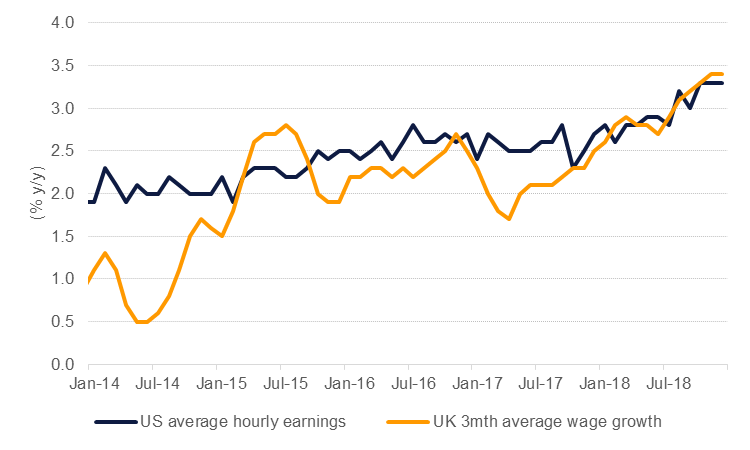
UK labour market data continues to display signs of resilience amidst the uncertainty over Brexit. The unemployment rate in the three months ending December held steady at 4%, in line with market expectations, while average earnings ex-bonuses growth improved slightly to 3.4% y/y over the same period. The positive labour data sits at odds with a survey of confidence on household finances which hit an 11 month low with job security a prominent source of anxiety. Meanwhile, several large industrial firms have recently announced plans to shut down projects or move investment elsewhere in response to the uncertainty surrounding Brexit.
Germany’s ZEW survey of investor sentiment remained in negative territory in February at -13.4. It was a marginal improvement from the -15 recorded in January. However, the assessment of current conditions fell sharply m/m from 27.6 to 15. Uncertainty over trade relations, particularly with the US now considering tariffs on automobile imports, and the ongoing debate over Brexit are compounding a slowdown in Germany’s economy which was flat in the final quarter of 2018.
Exports from Japan fell by 8.4% y/y in January, their largest decline since October 2016. The decline in exports follows on from soft surveys of business optimism in both the manufacturing and services sector of Japan’s economy. Exports to China fell more than 17% in January, compounded the effect of the Lunar New Year holidays.
The Egyptian government has issued USD 4bn of dollar-denominated bonds, with tenors of USD 750mn (five-year), USD 1.75bn (10-year) and USD 1.5bn (30-year). The issuance is part of the government’s strategy to reduce its dependence on expensive short-term debt, and to push the average debt maturity to five years by 2022. Along with a resumption of the rate-cutting cycle which began last week, the move will help reduce Egypt’s high levels of debt servicing costs.
 Source: Eikon, Emirates NBD Research.
ADNOC received a rating of ‘AA’ from Fitch, with the agency citing the national oil company’s strong performance, low upstream costs and conservative financial approach. Fitch noted the strong influence the Abu Dhabi sovereign exerts over ADNOC which acts as a cap on the rating. ADNOC has traditionally raised finance through export credit agencies of major import partners and is reportedly not actively seeking a public debt issue.
US treasury yields fell ahead of today’s release of the FOMC minutes as the market will be parsing the document for any more dovish indicators. New York Fed president John Williams poured water on the prospect for more rate hikes this year, saying a “new economic outlooks” was needed to see more rate hikes. Williams estimated that rates had reached a neutral level. Yields on the 10yr UST fell 2bps from Friday’s close and the 2-10yr spread compress marginally.
In the primary market, A/A- rated Mashreqbank raised USD 500 million via 5yr Reg S bonds that priced at MS+ 175bps – circa 25bps tighter than the original guidance.
GBPUSD had its best performance in a month on Tuesday after sentiment on the pound was boosted by comments from Conservative Steve Baker. These comment revealed that UK Prime Minister Theresa May will meet the President of the European Commission, Jean-Claude Juncker and remained optimistic that a deal could be reached. As we go to print, GBPUSD is trading at 1.3069, near two-week highs, and has climbed back above the 200-day moving average. Holding onto these gains will remain dependent on more positive developments and optimism regarding Brexit.
It was a tentative day for global equities as markets wait for the FOMC minutes out later on Wednesday and any update on the US-China trade talks. The S&P 500 ended the day up 0.15% while the Dow was roughly flat. In Europe, Both Germany and France recorded positive closes while the FTSE 100 fell 0.56%, helped lower by a move in sterling back up to a 1.30 handle.
Regional equities saw minimal movement. The DFM gained 0.6% while the Abu Dhabi exchange was flat and the Tadawul slipped by 0.6%.
Brent futures have struggled to push much beyond USD 66.50/b in the last three trading sessions. Brent closed at USD 65.45/b overnight while WTI played catch-up after a holiday on Monday to rise 0.9% and close at USD 56.09/b.
Iranian oil exports have been holding reasonably stable in 2019 as the importers of the nation’s crude use waivers from US sanctions to continue trade. Estimates for January exports are for roughly 1.1m b/d to 1.3m b/d while in February they are seen levelling out at around 1.25m b/d. Waivers on Iranian crude exports will expire later this year which could see markets tighten up considerably in Q2-Q3.
The EIA expects output from shale basins in the US to hit 8.5m b/d in March, up 84k b/d m/m and most of the growth will come from the Permian basin in Texas