
Recent Search
Popular Searches


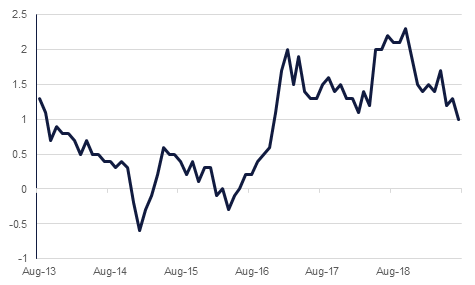
A monthly report from the Bundesbank released yesterday warned that German output would remain ‘lacklustre’ in the third quarter and could even contract. Given that data last week showed a Q2 contraction of -0.1%, this would indicate a recession for Europe’s powerhouse. In light of this, the government has indicated it could abandon its policy of balanced budgets and implement EUR 50bn of spending in light of a crisis. Eurozone inflation data in July was weaker than first reported two weeks ago, with final numbers released yesterday showing y/y price growth of 1.0%, not 1.1%. This is down from 1.3% in June, making an announcement of monetary easing in the September ECB meeting – Mario Draghi’s last at the helm of the bloc’s central bank – even more likely. The bank is focused on inflation numbers, but the weak outlook for the EU’s largest constituent, Germany, will also increase the likelihood of fresh stimulus. This week sees the release of the minutes from the ECB’s July meeting, which should give some indication as to the MPC’s thinking, as well as preliminary PMI figures for the bloc, a timely indicator of economic output.
US President Donald Trump has renewed his public calls for a rate cut, tweeting that there should be a reduction of at least 100bps over ‘a fairly short period of time, with perhaps some quantitative easing as well.’ All eyes will be on Fed Chair Jerome Powell’s speech at Jackson Hole on Friday to see if there are any indications of the central bank’s likely monetary policy stance going forward.
UK Prime Minsiter Boris Johnson has written to the European Council, looking to find an alternative to the controversial Irish backstop which is at present a major stumbling block to the UK and the EU coming to a Brexit deal before the October 31 deadline. The proposal however was short on specifics, suggesting that the EU – which has been resolute that the withdrawal agreement will not be renegotiated – might not be convinced. Johnson is to meet his counterparts in France and Germany this week.
 Source: Bloomberg, Emirates NBD Research
Treasuries closed lower as risk appetite returned. Comments from the US President suggesting that the Fed should cut rates by as much as 100 bps had no impact. Yields on the 2y UST, 5y UST and 10y UST closed at 1.54% (+7 bps), 1.47% (+6 bps) and 1.60% (+5 bps) respectively.
Regional bonds continue to move broadly in line with changes in benchmark yields. The YTW on Bloomberg Barclays GCC Credit and High Yield index rose +1 bp to 3.22% and credit spreads dropped -5 bps to 165 bps.
Fitch affirmed Emirate of Ras Al Khaimah’s rating at A with stable outlook.
On the Bloomberg Dollar spot index, the greenback climbed to its highest level this year yesterday, despite US President Donald Trump’s calls for greater rate cuts in the US. President of the Federal Reserve Bank of Boston, Eric Rosengren, cast doubt on the need for any further cuts, while news of stimulus in Germany also played a part. This morning the dollar has weakened modestly against the Euro and GBP.
Developed market equities closed higher amid some dialing back of trade tensions. The S&P 500 index and the Euro Stoxx 600 index added +1.2% and +1.1% respectively.
Regional equities closed mixed with the DFM index losing -0.2% and the Tadawul adding +0.5%. Zain Saudi closed lower following reports that the company is in talks with the government to convert all or part of its debt into equity.
Oil prices started the week on a stronger footing, supported by expectation of stimulus from major economies and a reported drone attack on the Shaybah oil field in Saudi Arabia. Brent futures rose 1.9% to end the day at USD 59.74/b while WTI closed up 2.4% at USD 56.15/b. There is little economic data out today that will affect prices thus we expect headlines to remain the significant factor in setting a trajectory for crude.
Gold prices moved back below USD 1,500/troy oz as risk assets generally rallied on hopes that central banks and governments in major economies would introduce further stimulus measures. The Jackson Hole meeting of central bankers this weekend may give a sign how much more accommodative monetary policy may be on the cards, which may provide a short-term boost to gold.
 Daniel Richards

 Facebook
 Twitter
 Linkedin
 Email
Email