
Recent Search
Popular Searches


The recent pick-up in pace in India’s Covid-19 vaccination programme, combined with steadily falling Covid-19 case numbers, is giving rise to optimism with regards to the Indian economic recovery over the coming months. The first quarter of fiscal 2021/22 will have been weaker than previously anticipated, and we have revised down our full-year growth forecast from 10.4% - which had been below consensus at the start of the year – to 9.0%. Nevertheless, provided the country manages to avoid another major wave of the disease the outlook is relatively bright given the ongoing recovery and related base effects, expectations for a decent harvest, and sizeable fiscal stimulus. The RBI will also keep policy loose despite rising inflation, which it sees as transitory.
 Source: Bloomberg, Emirates NBD Research
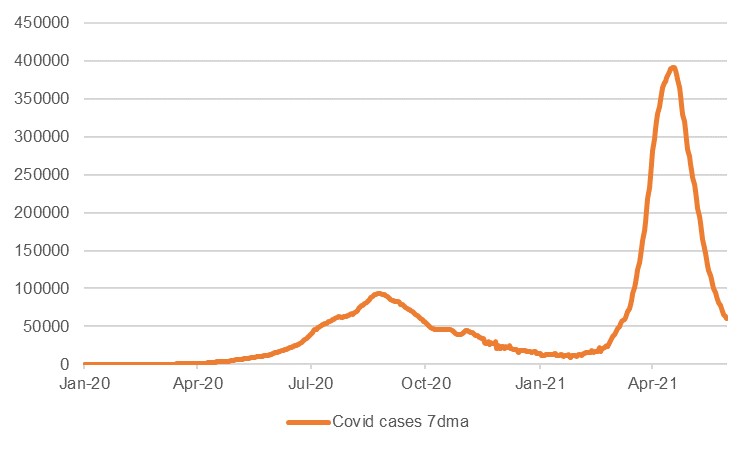
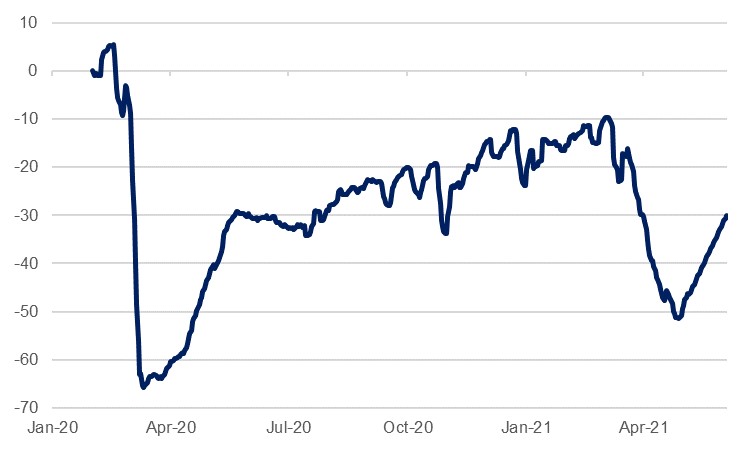
The second wave of the pandemic that began in India in March saw new daily case numbers in India peak at over 400,000 a day in May, necessitating renewed restrictions on movement and activity. While there was no country-wide lockdown imposed, most states around the country put restrictions in place with the economically significant states of Maharashtra and Delhi amongst the first and worst affected. The effect of these measures can be seen in Google mobility data, which shows that footfall at workplaces, having recovered to around -10% below the pre-pandemic baseline, fell back to -51%. While manufacturing posted significant y/y gains in April owing to the complete lockdown seen in April 2020, on a monthly basis there was a reversal on March 2021’s m/m growth. Intermediate goods, primary goods and capital goods production declined -11.0%, -12.6% and -23.5% m/m respectively in April.
 Source: Bloomberg, Emirates NBD Research
At the close of the first quarter, the situation in India is looking more positive. Daily case numbers have fallen to under 60,000 each day and there has been progress on vaccinations. The percentage of the population that is fully vaccinated is still low – under 5.0% – but a pledge to provide free vaccines after initial confusion has helped the authorities ramp up the daily doses administered to 7.5mn a day. This has enabled state authorities to ease some of the restrictions in place, and footfall at workplaces has recovered to -30.0% off the baseline.
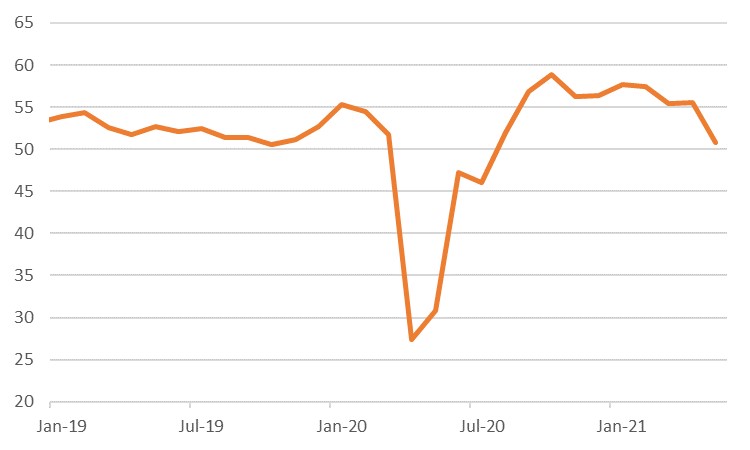
However, while there has been an easing, there remain curfews and limits on numbers allowed in hospitality venues in many states. In addition, until a higher number of the population is fully vaccinated, fears of possible infection and a potential third wave will also limit take-up of hospitality services. Footfall at retail and recreation remains some -40% off pre-pandemic levels, and the services PMI has fallen back below the neutral 50.0 level for the first time since September last month, coming in at 46.4.
 Source: Google, Emirates NBD Research
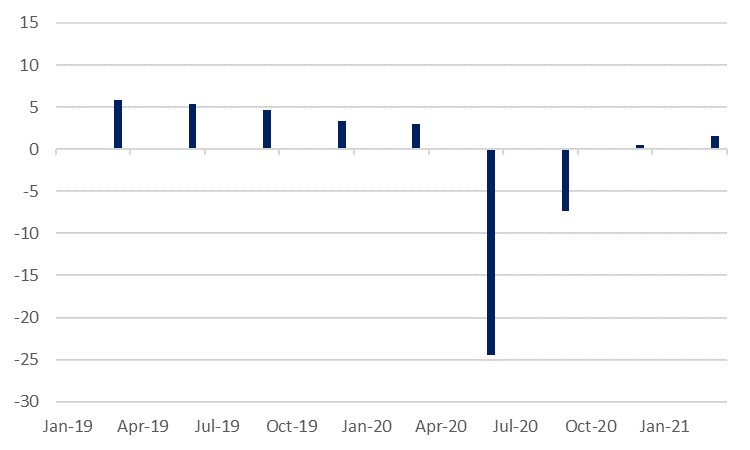
While the second wave means that growth this year will be weaker than previously expected, it will likely be one of the strongest expansions amongst major global economies nonetheless. This owes much to base effects – India’s economy shrank by -7.3% last year, and the dip in the composite PMI survey to just 7.2 in April 2020 was a stark illustration of the pressures the economy was under. Provided that there is no equally devastating third wave, the recovery alone should provide a significant boost to annual growth. On current trends this will be driven largely by the manufacturing sector, with services likely to lag over the coming months.
 Source: Bloomberg, Emirates NBD Research
There is potential for the agriculture sector to provide a boost to growth, but the risks to this are mounting. The India Meteorological Department (IMD) has forecast that the monsoon will bring rainfall just over the long-term average, which should result in a boost in output, provided it is not impeded by a wave of the pandemic in rural areas. The second wave was initially concentrated in the major cities, but two thirds of new cases are reportedly now emerging in rural and semi-rural districts, and the RBI cited a decline in tractor sales as possible evidence that the rural economy is not firing on all cylinders.
Aside from the vaccination rollout, other factors that will be key to India’s recovery are the fiscal and monetary stimulus the authorities are providing. Finance Minister Nirmala Sitharaman's budget, announced in February, allows for significant increases in spending in the current fiscal year which will push the fiscal deficit close to -10.0% of GDP. This includes a 137% boost to healthcare spending, and a new investment vehicle which will fund infrastructure projects. Notably, a planned governmental disinvestment from key areas, and increasing the level of foreign control allowed in the financial services sector, should encourage a ramp-up in FDI inflows.
The RBI has also done its part to boost growth with a formalisation of its QE programme in April as it announced that it would purchase USD 14bn of bonds in the quarter. While inflation has picked up to 6.3% in May (above the target range’s upper bound of 6%), the highest level since October, the RBI is holding to the line of central bankers around the world that this upward trend is transitory. Clearly prioritising the recovery over curbing price growth, the RBI doubled down in June with a plan for a further USD 16.4bn of asset purchases in the second quarter as it aims to help keep borrowing costs low. This commitment to the recovery was underlined by RBI Governor Shaktikanta Das’s statement in the June MPC minutes that ‘The dent on economic activity due to the second wave of the virus has necessitated the continuation of monetary measures to support the process of economic recovery to make it durable.’
 Daniel Richards

 Facebook
 Twitter
 Linkedin
 Email
Email